
Why laminate makes sense in transport interiors
Designing transport interiors means balancing aesthetics with performance. From stations to ship interiors, laminate offers design freedom, consistency across large-scale rollouts and long-term durability, without compromise.
Balancing design ambition, fabrication efficiency and long-term performance
Designing interiors for transport environments, whether vehicles, stations or passenger hubs, presents a unique set of challenges. These spaces are subject to constant movement, high footfall, tight maintenance windows and strict safety requirements, all while needing to deliver a consistent, considered passenger experience.
Material choices must therefore work harder than in many other commercial settings. They need to support design intent, streamline fabrication and installation, and stand up to years of intensive use with minimal disruption. Laminate continues to be specified across transport projects for precisely these reasons.
A design-led material for demanding environments
For architects and interior designers
High-pressure laminate offers designers a rare balance of creative freedom and technical reliability. With a wide range of colours, patterns and textures available, from solid colours and subtle matt finishes to convincing wood, stone and abstract effects, laminate sheets from the Formica® Collection enable strong visual concepts without the compromises often associated with natural materials in transport settings.
Consistency is also key. Transport projects frequently span multiple areas, multiple vehicles, stations or terminals, where maintaining a cohesive design language is essential. High-pressure laminate allows for repeatable results across large-scale rollouts, helping designers retain control over colour, texture and finish long after the initial installation.
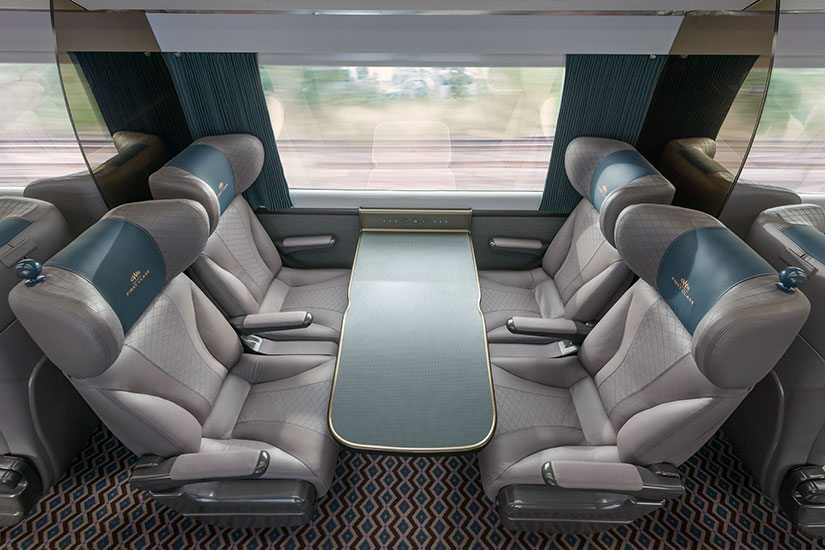
See how First Great Western chose Younique® by Formica Group to replicate an original, colourful and patterned design onto its First Class table tops.
Crucially, laminate supports modern transport design priorities: lighter constructions, thinner build-ups and clean detailing. This makes it well-suited to wall panels, bulkheads, seating elements, counters and washroom environments, where aesthetic, function, and durability must work together seamlessly.
Efficient to fabricate, install and replace
For fabricators and installers
From a fabrication perspective, laminate is a practical and predictable material to work with. It can be cut, machined and edged using standard fabrication techniques, making it compatible with CNC processing and repeatable production runs, making it ideal for transport interiors where precision and efficiency matter.
Its lightweight nature offers clear advantages during manufacture and installation, particularly in vehicle interiors or retrofit projects where handling, access and installation time are critical factors. Compared to heavier materials such as solid timber or metal, laminate helps reduce physical strain and speeds up installation without compromising performance.
Check out this furniture range by Meble Morskie, who chose Formica Laminate as a lightweight durable material to build ship furniture.
Should individual panels become damaged over time, they can often be replaced quickly and efficiently, minimising disruption to services.
Designed for longevity and easy maintenance
For operators, asset owners and end clients
For transport operators, the true value of a material lies in its long-term performance. Laminate surfaces are engineered to withstand the daily realities of transport environments: constant use, repeated cleaning, exposure to moisture and the occasional impact or abrasion.
Smooth, non-porous surfaces make laminate sheets easy to clean, which is an essential consideration in high-traffic public spaces. Its resistance to stains and scuffs helps interiors retain their appearance over time, reducing the need for frequent refurbishment.
From a lifecycle cost perspective, its durability, combined with straightforward maintenance and repair, helps limit downtime and keeps assets in service for longer, an important factor where operational continuity is critical.
Explore this calming blue-toned palette for transport environments, ideal for designing neuro-inclusive travel spaces.
A balanced material choice for modern transport design
Whether specified for a cruise ship, train carriage, airport terminal or urban transport hub, laminate supports the complex demands of transport interiors. It gives designers the freedom to realise strong visual concepts, helps fabricators work efficiently and safely, and provides operators with a durable, easy-to-maintain surface that performs over time.
In environments where movement is constant, and expectations are high, laminate proves itself as a material that balances design, practicality and longevity, making it a smart choice for transport projects of every scale.
Explore the possibilities for your next transport project with Formica Laminate
Category
Related Articles


